
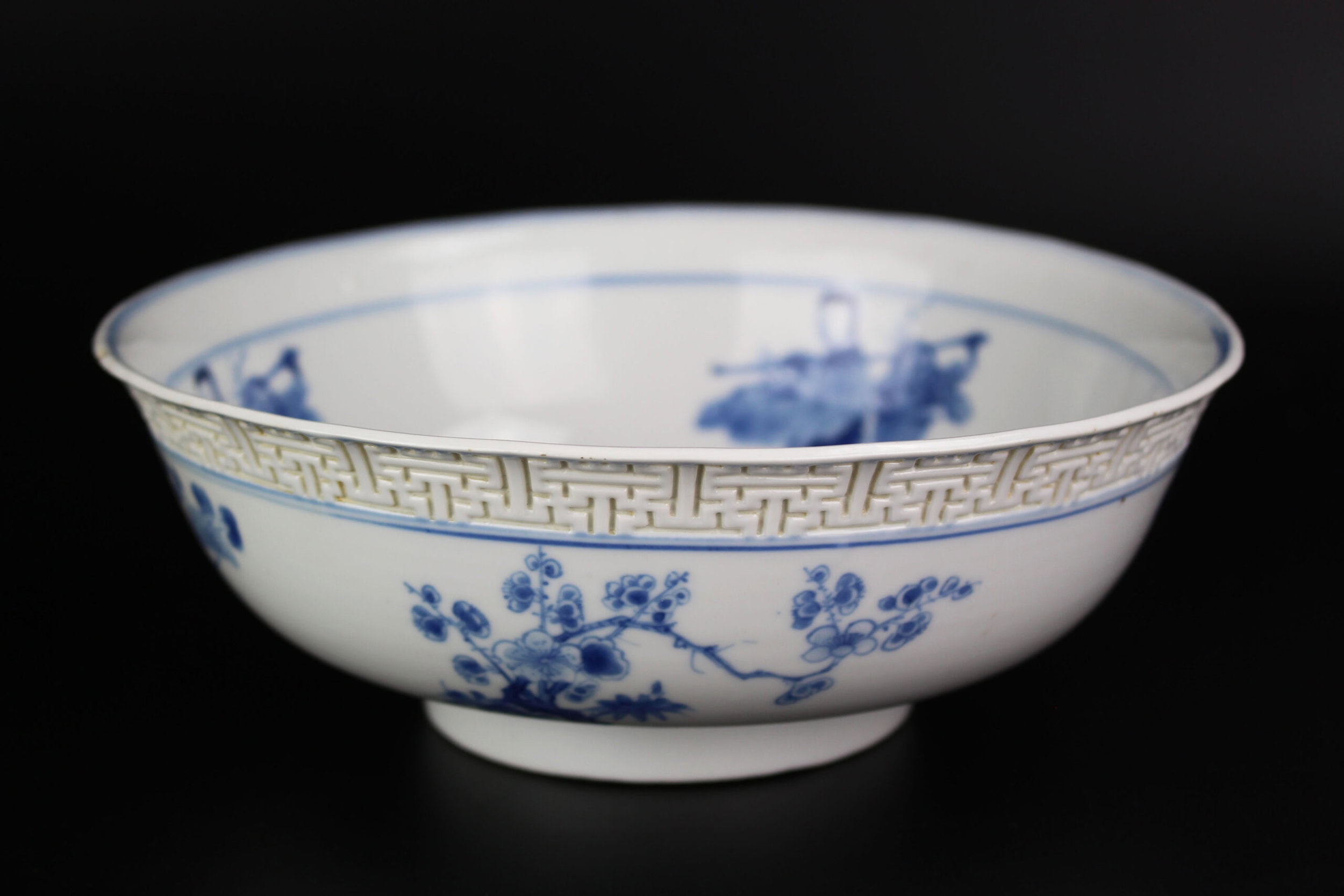
A blue and white bowl with various Taoist symbolic decorations.
Kangxi period (1661-1722), c. 1700-1720, China.
The low bowl with interesting convex centre and flared wall.
The inside showing four figures representing Lan Caihe holding a ruyi and a flower basket, slung on a hoe (ancient farming tool) over the shoulder. The convex centre surrounded by a band showing the Eight Treasures (pearl, rhinoceros horn, shell, fishes, never-ending knot, books and a coral stick).
The outside with a band of Wan or Swastika’s in relief with the recess background cleverly showing the biscuit of the porcelain. Underneath the upper swastika band showing the Flowers of the Four Seasons. Underneath the flowers a band of ruyi heads, the bowl resting on a high footring with concave centre.
About Lan Caihe:
Lan Caihe is one of the eight Taoist immortals and the patron saint of florists and gardeners. Sometimes portrayed as a woman, other times as a hermaphrodite, Caihe is a symbol of elusive pleasure and represents innocence and happiness. It is said Lan Caihe wandered the streets as a beggar in worn clothing and with one foot bare, denouncing the elusive pleasures of this fleeting life.
About the Eight Treasures:
Also known as ba bao, this early motif of eight symbols was not merely a decorative pattern that occurred on Chinese works of art, but originally had a symbolic importance reflecting aspirations for status, wealth, and position as well as philosophic allegiance.
About the Flowers of the Four Seasons:
This representation is frequently seen in paintings or depictions on porcelain. A flower or plant representing each of the seasons: plum blossom for winter, grass orchid for spring, lotus for summer and chrysantemum for autumn.
About the Wan or Swastika symbol:
The Wan has been used as a design motif in every imaginable medium. In spite of contrasting views on its origin, it is historically tied to Buddhism and in Chinese folklore it symbolised good luck and eternal abundance. The term Swastika is derived from the Sanskrit su “well” and as “to be”, meaning “so be it” and denoting resignation of the spirit. It is styled the “ten thousand character sign” (wànzì) and is said to have come from heaven. It is described as “the accumulation of lucky signs possessing ten thousand efficacies”. It is also regarded as the symbol or seal of Buddha’s heart and is usually placed on the heart of Shâkyamuni Buddha.
Provenance:
From a private Dutch noble collection.
Identical bowls can be found in several museum collections:
Victoria & Albert Museum London (accession number C.941-1910)
Rijksmuseum Amsterdam (object number AK-NM-6845)
Groninger Museum (object number 1899.0360)
Museum Arnhem (inv. nr. GM10.412).
Lit:
Hartog, Stephen – Pronken met Oosters Porselein, p. 67 / nr. 49.
Dimensions:
Diameter 19.2 cm, height 7.1 cm.
Inv. No: A00389
