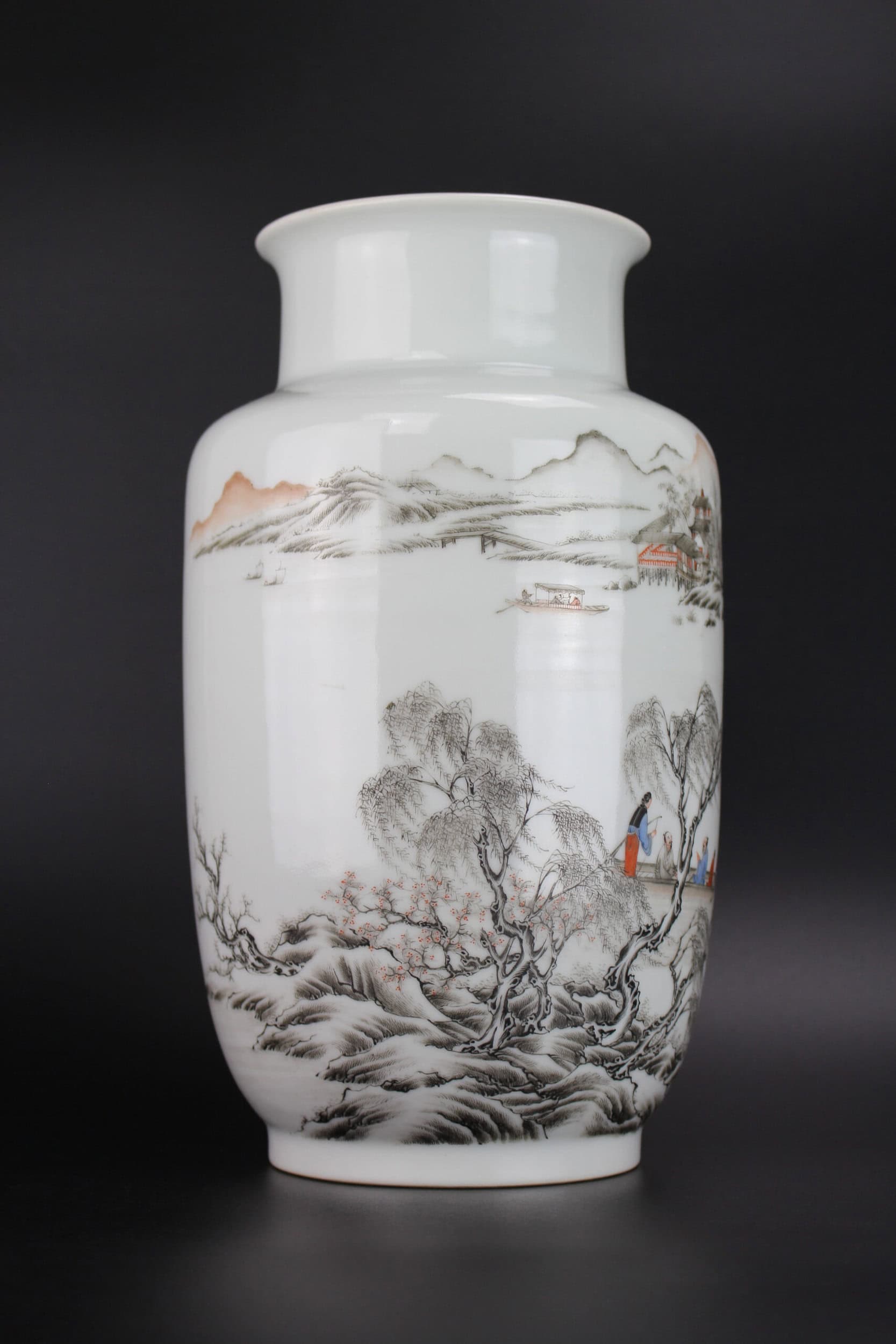
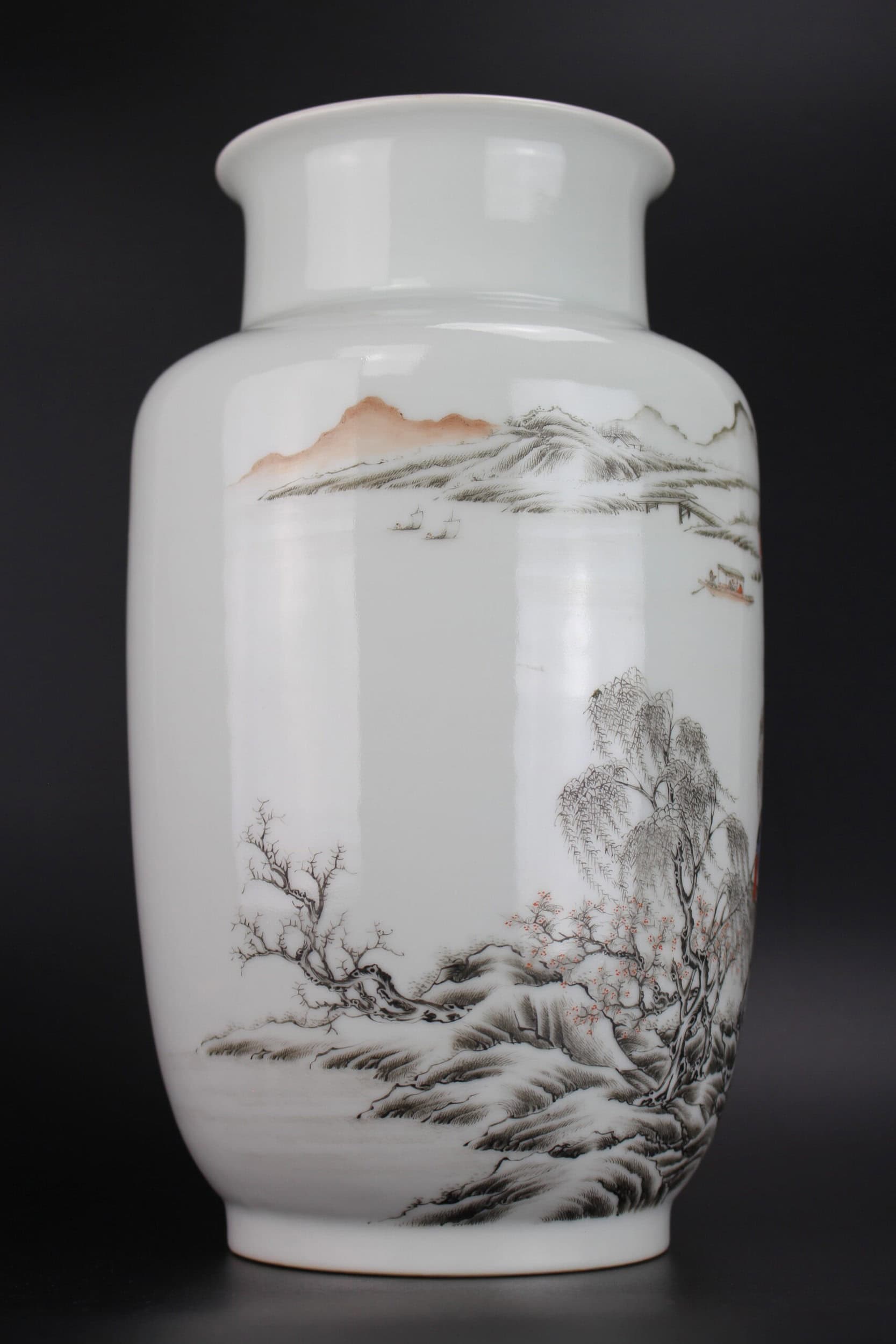
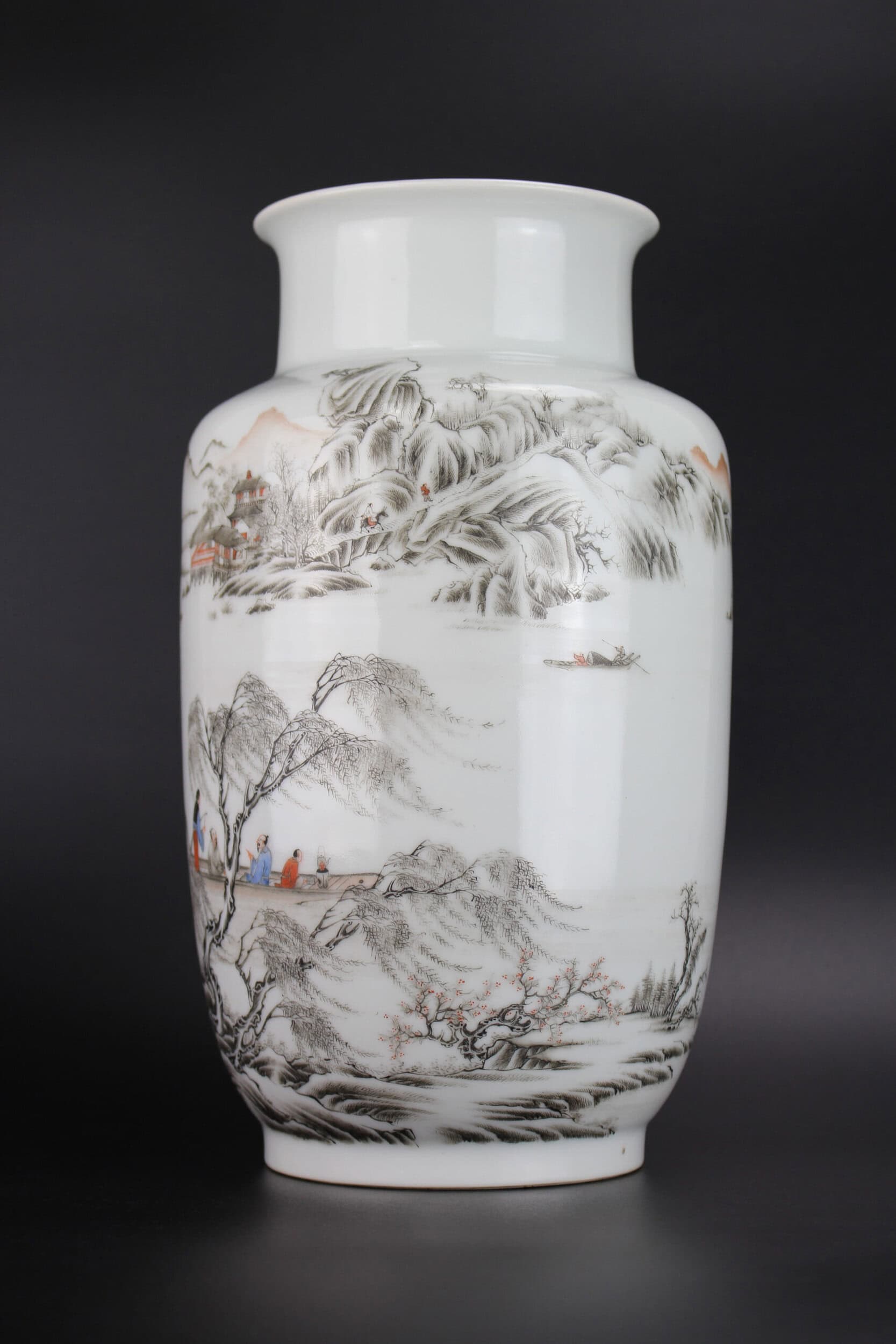
A fine and rare grisaille-enameled ‘river landscape’ vase.
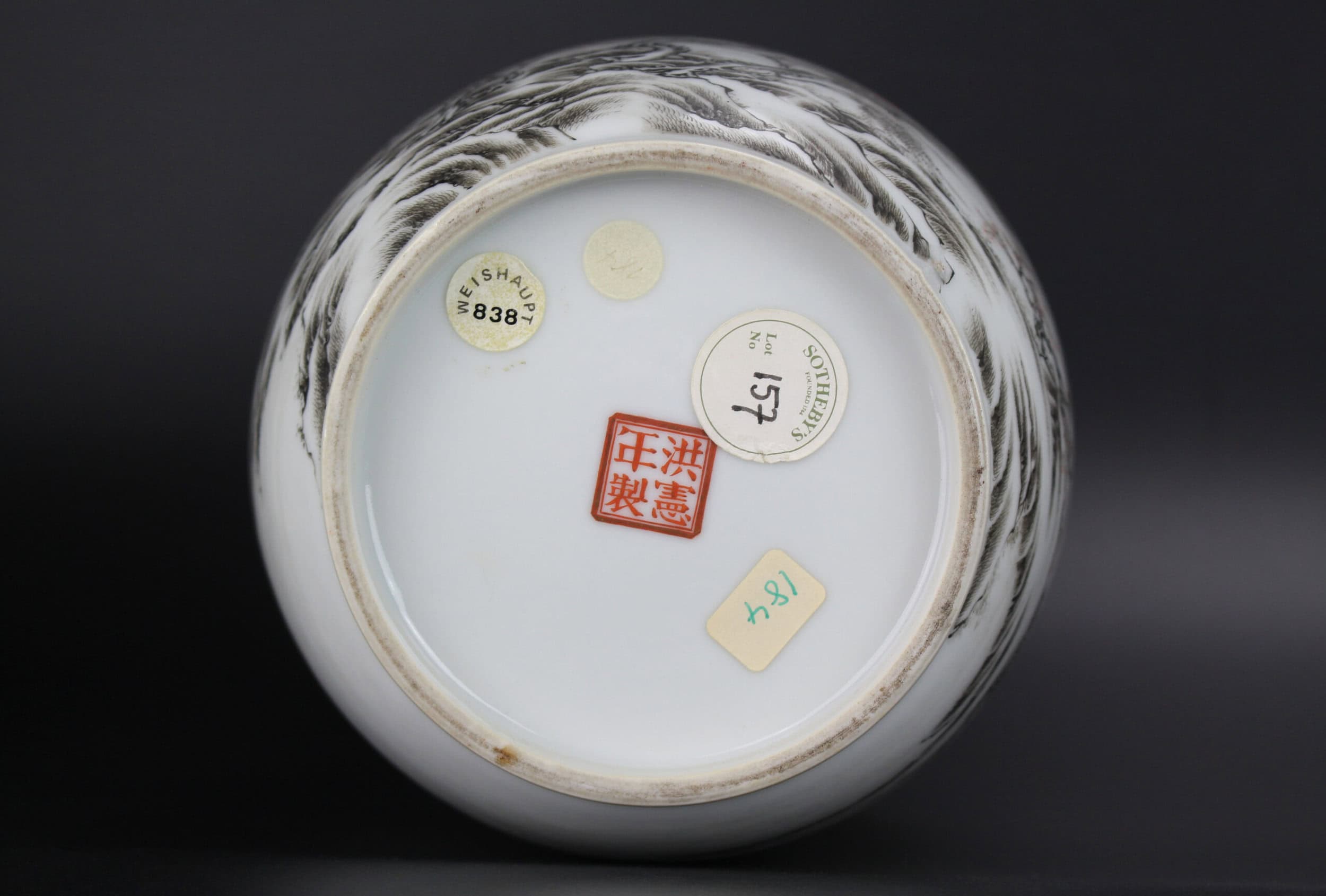
Iron-red Hongxian nian zhi four-character seal mark within a double square and possibly of the period or Republic Period, ca. 1915-1935.
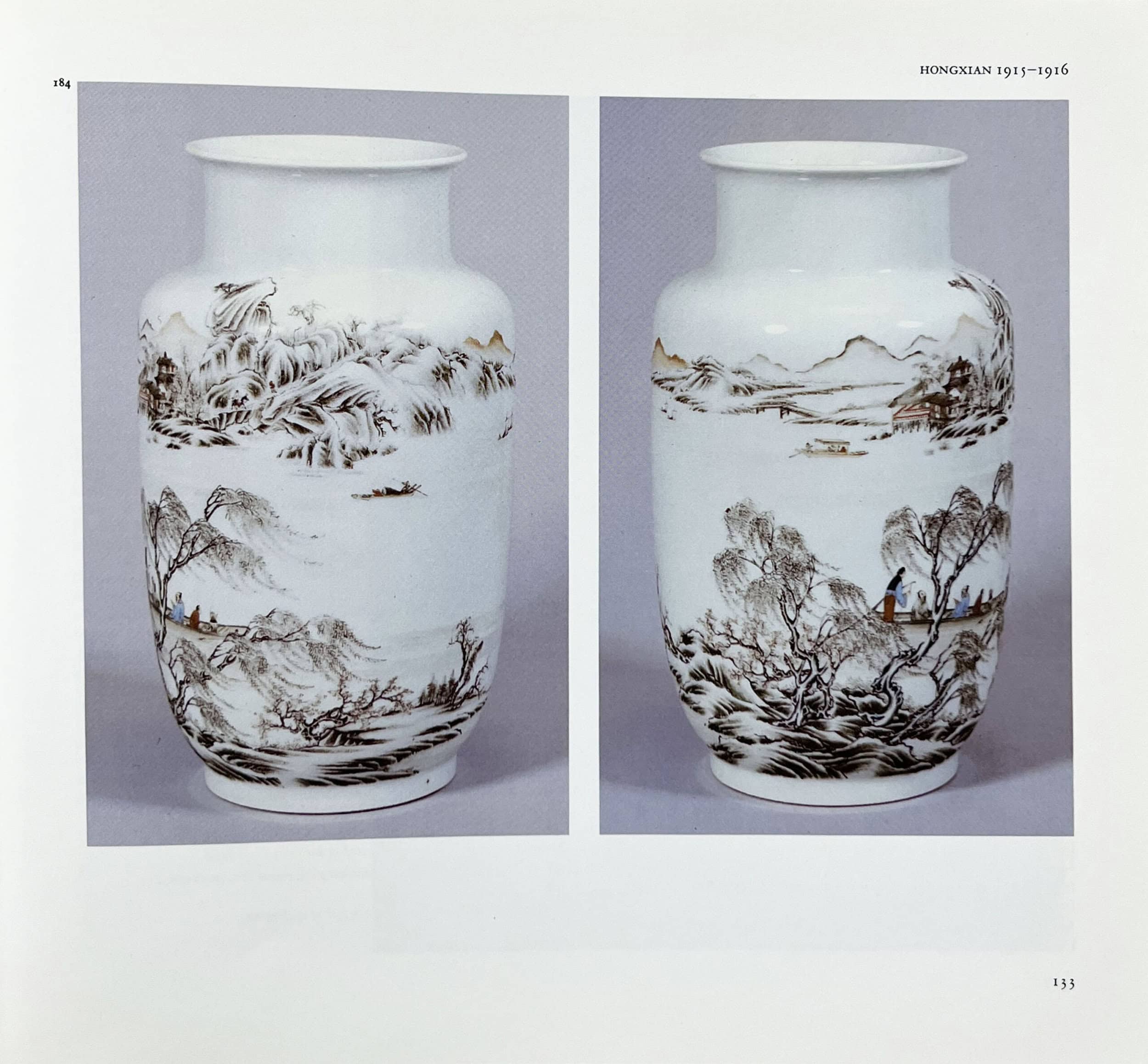
The thinly potted translucent body of ovoid form surmounted by a waisted neck with everted rim, delicately painted over the glaze in black, pale blue, sepia and iron-red tones against a white background with a pure glaze.
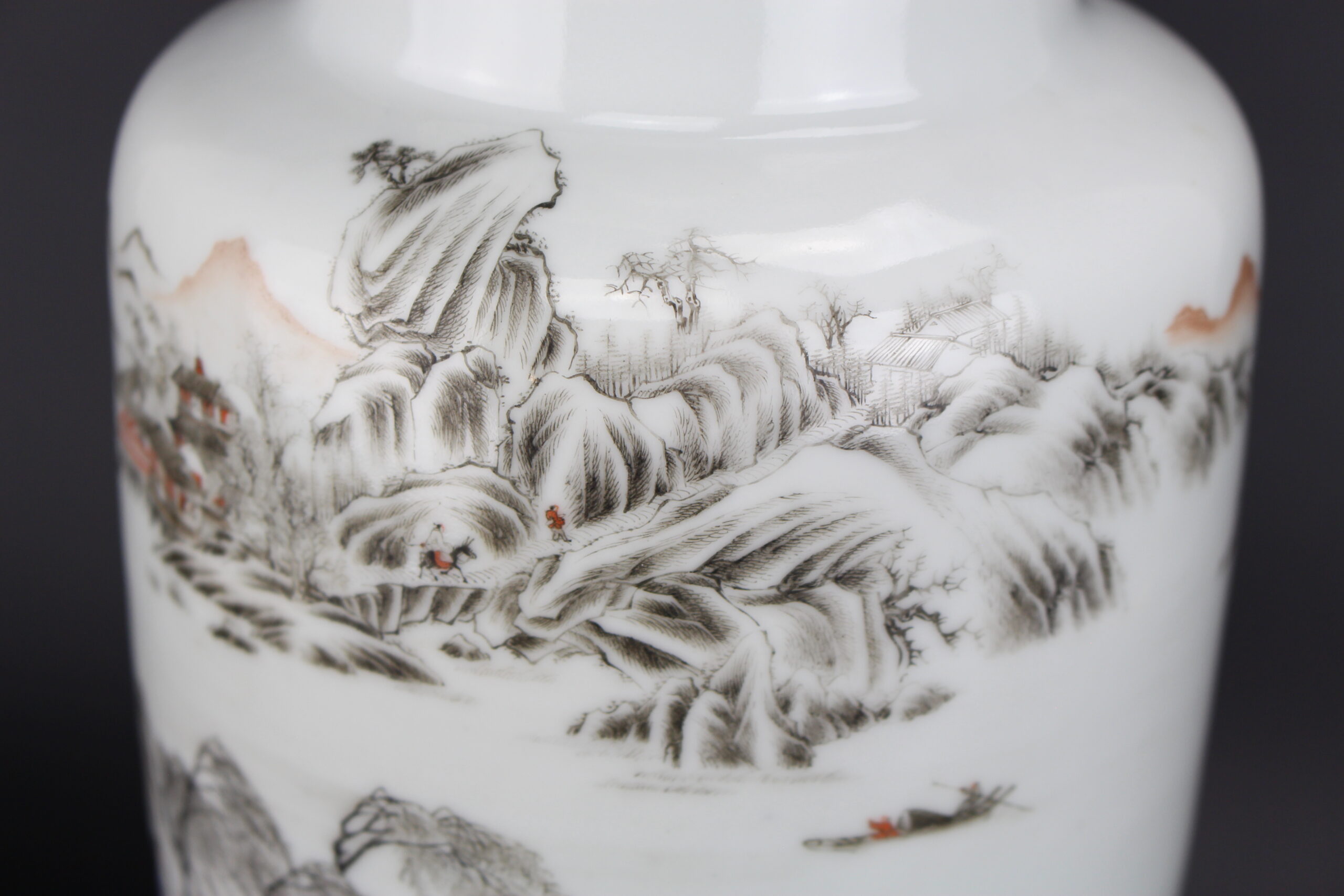
The upper part of the scene shows a masterfully painted broad landscape panorama exquisitely drawn in grisaille, the sparing use of colour accentuating the scene. In the foreground, not far from the rocky shore, a boat is drifting beneath the willows. Two scholars are in animated discussion, while a servant warms wine. On the far side of the lake, upon which other boats are drifting, is an imposing building in a bamboo grove in a ravine among rugged mountains. A scholar is riding his donkey down a steep mountain path. He is preceded by his servant carrying a zither. The mountains in the background are lost in the mist.
The vase is marked on the base with a finely painted iron-red Hongxian nian zhi four-character seal mark within a double square, Weishaupt and Sotheby’s stickers adhering to the base.
A striking feature of this vase is the whiteness of the body and the purity of the glaze, both elements seen in all high-quality Hongxian and Juren Tang marked pieces.
The fine craftsmanship becomes even more evident when looking at the intricate landscape painting that adorns the vase. The exquisitely decorated scene is done in a painterly style as if it were a scroll painting. The brushwork is both delicate and deliberate, showcasing a mastery of traditional techniques. The subtle gradations in color and texture create a sense of depth and movement, as can be seen when looking the grisaille-enameled rockwork and trees on the foreground, painted with hard and strong brushstrokes, creating a sense of depth to the softer and more delicately painted background scene and as a result drawing the viewer into the serene scenery. This level of detail not only highlights the skill of the artisan but also aligns with the high standards of Hongxian-era porcelain production.
Provenance:
Formerly in the Georg Weishaupt collection, exhibited at the Museum für Kunsthandwerk, Frankfurt am Main, June 25 to August 13, 1987, and exhibited at the Museum für Kunsthandwerk, Berlin, Autumn 1987, illustrated in Vom Schatz der Drachen / From the Dragon’s Treasure (Gunhild Avitabile, 1987), pp. 132-133, no. 184.
Sold at Sotheby’s Amsterdam, The Weishaupt Collection of 19th and 20th Century Chinese Porcelain, 16th October 1995, lot 157, p. 46 / p. 49.
Private collection, The Netherlands.
Ref:
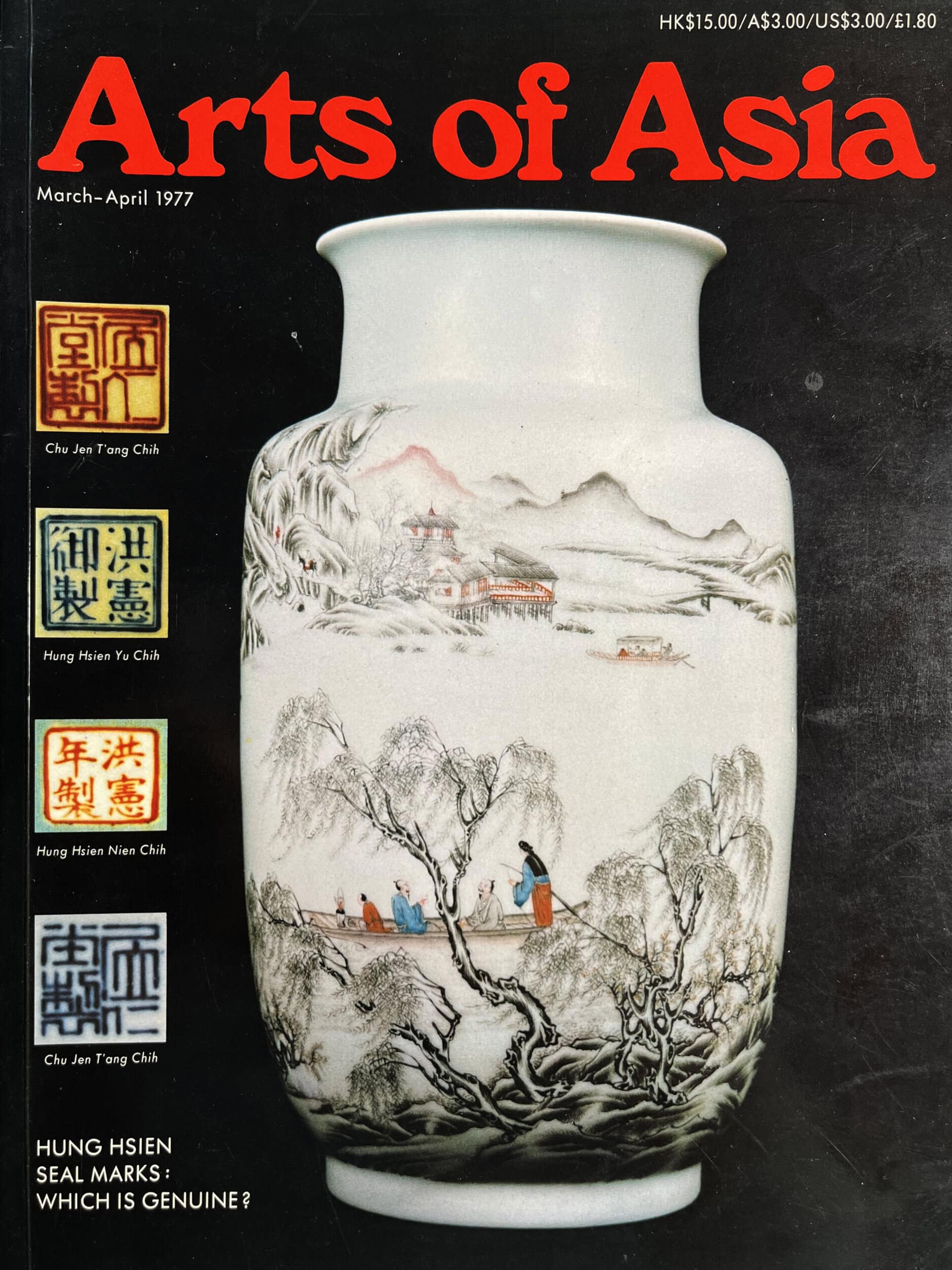
A vase with identical shape and decoration but mirrored in design, from the collection of Hugh M. Moss, was illustrated on the cover of Arts of Asia magazine, Vol. 7, Number 2, March – April 1977.
Compare with two mirrored-pair ‘river landscape’ vases of different form but painted in a similar style, gifted by Queen Mary to the Victoria and Albert Museum, one bearing an iron-red “Juren Tang” mark within a double square and the other with an iron-red Hongxian mark, accession numbers C.567A-1925 and C.567-1925, illustrated in Chinese Ceramics Porcelain of the Qing Dynasty 1644-1911 (Rose Kerr, 1986), pp. 128-129, no. 115 and illustrated in Chinese porcelain of the 19th and 20th centuries (H.A. van Oort, 1977), pl.153.
Also compare with two mirrored-pair vases of different form but painted in a similar style, bearing a blue Hongxian mark within a double blue square, in the collection of the Metropolitan Museum of Art, New York, accession numbers 68.4.1 and 68.4.2 and illustrated in How to Read Chinese Ceramics (Denise Patry Leidy, 2015), pp. 140-141, no. 41.
Also compare with a Hongxian Yuzhi marked grisaille-decorated ‘landscape’ vase, sold at Christie’s, 29 May 2013, The Yiqingge Collection of Chinese Ceramics, lot 2033.
Dimensions:
Height 26.5 cm, diameter 15 cm.
Condition:
Perfect condition.
Inv. No: MW146
For more information on this vase, please refer to our blog post: https://menkenworksofart.com/a-hongxian-river-landscape-vase-mark-and-period-or-republic/