


In light of a new acquisition to our collection, which can be seen pictured above, we decided to create a blog post on this important piece. Next to it being a good quality blue and white porcelain, we wanted to highlight this small blue and white jar because it testaments to the early cross-cultural heritage between China and Europe, more precisely Portugal. It was made during the turbulent late Ming dynasty, dated ca. 1610 – 1630, between the reigns of emperors Wanli (1573-1620), Tianqi (1621-1627) and Chongzhen (1628-1644). Whilst doing background research one can find himself amazed by the interesting background story attached to this jar.

Above: A very rare Chinese blue and white jar for the Portuguese (most likely Jesuit) market. Ming dynasty, c. 1610 – 1630.
From our gallery collection, Inv. No: MW305.
At first, the combination of angelic figures with Chinese-inspired floral patterns might seem purely decorative and influenced by Western aesthetics. But it is closely related to a jar of similar form but with hexagonal body (see image below) in the Fundação Medeiros e Almeida, Lisbon. Instead of flowers, it bears the emblems of Christ’s Betrayal, Crucifixion, Passion and Descent from the Cross:

So now a deeper Christian symbolism becomes apparent, even in this seemingly ornamental context. The pairing of angels with grape motifs further suggests a Eucharistic theme—though the usual symbol of wheat is missing, its presence may be subtly alluded to through the floral designs. These small vases, likely inspired by European metalwork or goldsmith objects, were possibly intended for use within church interiors, perhaps serving a decorative or maybe even a ritualistic function.
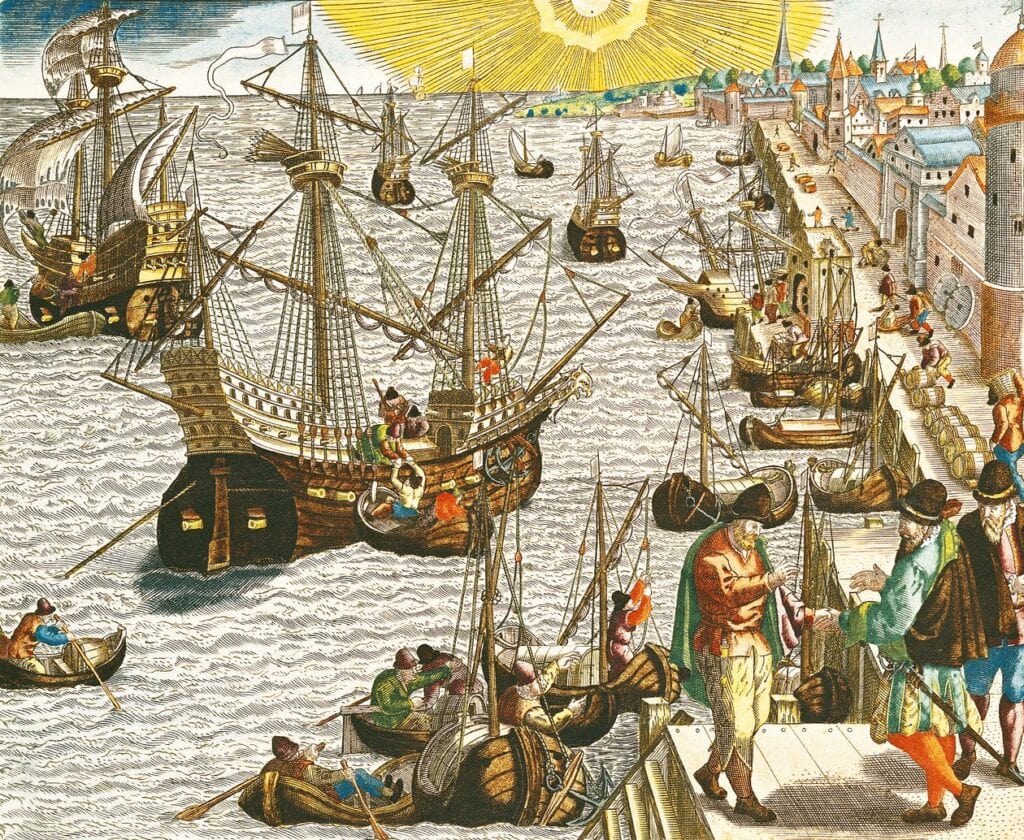
Above: Ships departing from the harbor of Lisbon bound for the Portuguese colonies. Engraving from 1592 by Theodor de Bry.
To create a better idea of the historic background of this piece, let’s look at the role of the Portuguese in Ming-dynasty China. The Portuguese first arrived in China in 1513 when explorer Jorge Álvares reached the southern coast near Canton (Guangzhou). By 1557, they established a permanent settlement in Macau with the approval of the Ming Dynasty, mainly to facilitate trade between China, Japan, and Europe. This made Portugal the first European power to establish a foothold in East Asia.

Above: Map showing Portuguese trade routes.
This marked the beginning of the shipment of millions of pieces of Chinese porcelain exported to Europe. Subsequent the first European motifs on Chinese porcelain date from this period. Initially painted with Portuguese designs, by the late 16th and early 17th centuries they began featuring the coats of arms of Spain and its rulers.

Above: A blue and white pilgrim flask for the Portuguese market, made by royal commission during the Wanli period, ca. 1610–1620.
This example bears the coat of arms of King Philip II, quartered with a cross in the center. Collection of Casa-Museu Dr. Anastácio Gonçalves, Lisbon. A similar pilgrim flask was auctioned at Sotheby’s, April 20, 2023, lot 45.
The emperors of the Ming dynasty largely kept China closed for Europeans. The only Europeans allowed access to inland China were the Jesuits. Many decorations on porcelain destined for export to Portugal or Portuguese trading posts thus contained Christian symbolism.

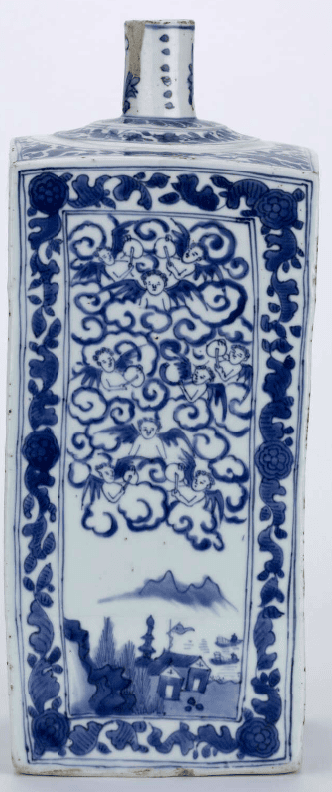
Above: A Chinese flask with symbolic decorations of the death and resurrection of Christ. Featuring a landscape in Chinese style, with angels playing music above. This scene almost certainly represents the angelic choir at the inn of Bethlehem during the birth of Jesus. The decoration is in late Ming style and dates from the early 17th century. The shape is based on a Dutch glass or stoneware drinking flask. However, it is quite possible that this flask was specially commissioned by Portuguese Catholics from their trading post in Goa. The flask was found in India in the 19th century by a British railway engineer. Collection of the British Museum, London.


Above left: As stated before, the trade and exchange between China and the Portuguese began in the early 16th century. The Portuguese exported and traded blue and white porcelain throughout Europe. This vase is one of six known “Jorge Álvares bottles,” named after the Portuguese explorer who acquired them. The inscription around the shoulder of the flask, written upside down following a Portuguese model, is translated as “Jorge Alvrz had this made in the time of 1552 \[reign of King John III].” Collection of the Chinese University of Hong Kong, Art Museum.
Above right: A blue and white jar for the Portuguese market, featuring the emblem of the Order of Saint Augustine. Wanli period, ca. 1575–1600. The motif on this jar — a double-headed eagle holding a heart pierced with arrows — served as the emblem of the Catholic Order of Saint Augustine. In the 16th century, Augustinian monks founded monasteries in Mexico, the Philippines, and Macau. The jar was likely produced for missionaries at one of these locations. Although the jar probably served a functional purpose, its white porcelain body and cobalt blue decoration would have seemed luxurious to friars used to simple vessels. Collection of the Metropolitan Museum, New York.
The missionary strategy of the Jesuits was an attempt to spread the faith by introducing European technology and science to Chinese intellectuals. Key fields of focus were astronomy, mathematics, and cartography.
The most prominent Jesuits in China during this period were the German Johann Adam Schall von Bell and the Italian Matteo Ricci.
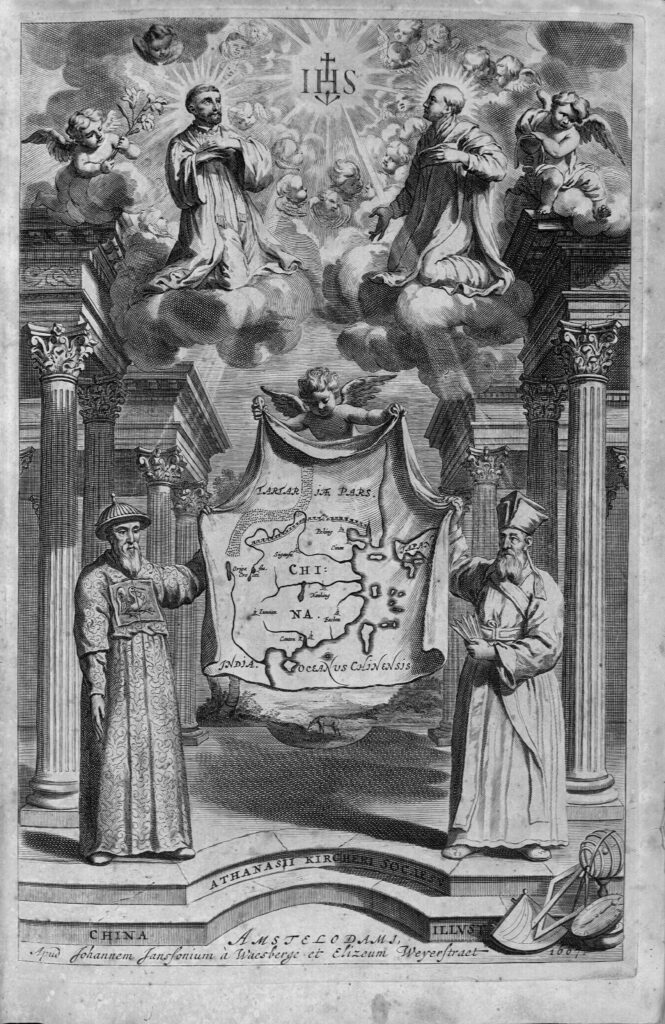
Above: Frontispiece of Athanasius Kircher’s *China Illustrata* from 1667, depicting Jesuit founders Francis Xavier and Ignatius of Loyola worshipping Christ’s monogram in heaven, while Johann Adam Schall von Bell and Matteo Ricci work on the Chinese mission.
Born in Cologne, Johann Adam Schall von Bell became a confidant of Emperor Shunzhi (r. 1644–1661), effectively making him the leading figure of the mission.
Matteo Ricci was the first European to enter the Forbidden City of Beijing in 1601 when he was invited by the Wanli Emperor, who sought his expertise in matters such as court astronomy and calendrical science. Ricci converted several prominent Chinese officials to Catholicism. He also collaborated with Chinese elites such as Xu Guangqi in translating Euclid’s *Elements* into Chinese and, for the first time in history, Confucian classics into Latin.
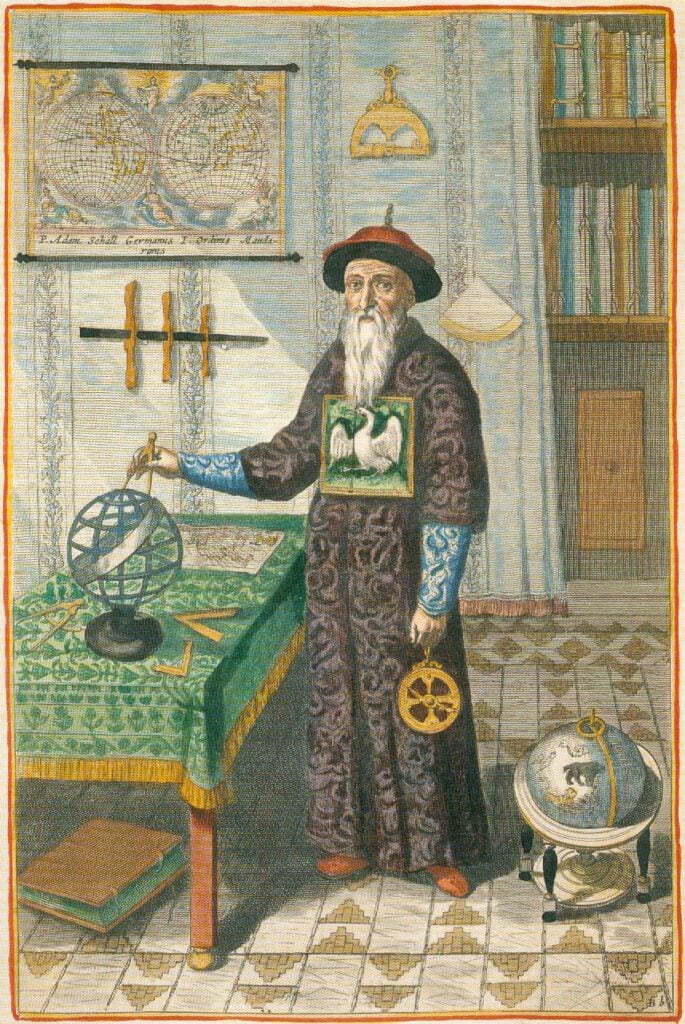

Left: A print of Jesuit Johann Adam Schall von Bell in his study, from *China Illustrata* by Athanasius Kircher (Amsterdam, 1667).
Right: Matteo Ricci with mathematician Xu Guangqi, one of the few elite Chinese converts, with whom he translated Euclid’s *Elements* into Chinese.
The history of the Jesuit missions in China is part of the broader history of Sino-Western relations. They played a crucial role in the transfer of knowledge, science, and culture between China and the West and influenced the Christian culture present in Chinese society today.

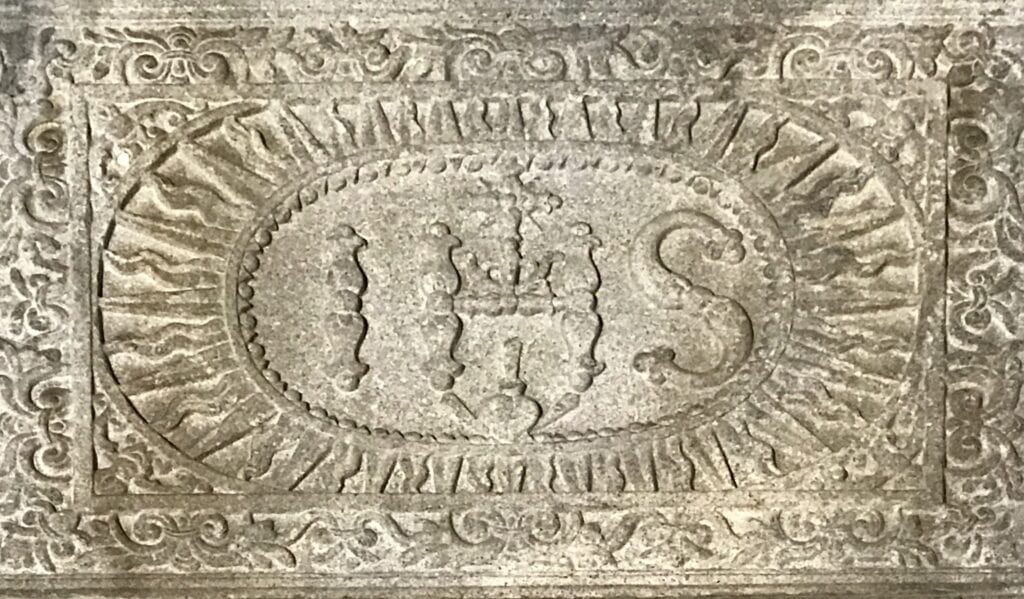
Left: A rare blue and white jar made for the Portuguese market, ca. 1610–1630 (late Wanli–early Chongzhen period). Bearing the Jesuit monogram “IHS,” crowned by a Latin cross. These jars are associated with St. Paul’s College in Macau, a school built in 1594 with funds from the royal senate and contributions from the citizens of Macau. Collection of Casa-Museu Dr. Anastácio Gonçalves, Lisbon.
Right: The IHS emblem of the Jesuits on the ruins of St. Paul’s College in Macau.
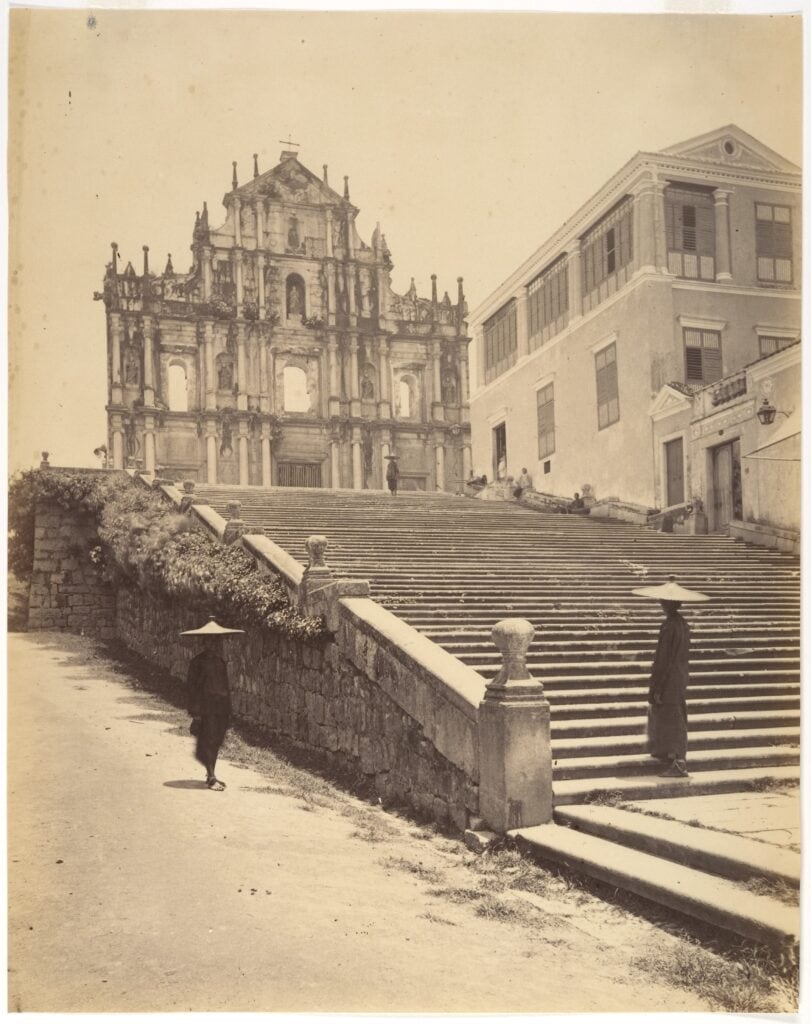

Left: A photo of the remaining facade of St. Paul’s College in Macau, ca. 1869, attributed to John Thomson, collection of the Metropolitan Museum, New York.
Right: A photo of St. Paul’s College in Macau, taken in 2013. The school was founded in 1594 by Alessandro Valignano as a stopover to prepare Jesuit missionaries traveling east. The academic program included core disciplines such as theology, philosophy, mathematics, geography, astronomy, Latin, Portuguese, and Chinese, as well as music and art. It had a significant influence on Western knowledge of Eastern languages and culture and was home to the first Western sinologists Matteo Ricci, Johann Adam Schall von Bell, and Ferdinand Verbiest, alongside many famous scholars of the time.
Despite the Jesuits’ connections with the Imperial court, Ming China remained largely isolated. Nonetheless, the Portuguese were granted Macau as a trading post under Chinese sovereignty. This was the only European trading post ever established in China.


Above left: Praia Grande, Macau, 19th-century engraving by W. H. Capone.
Above right: Praia Grande, Macau, photograph taken in 1868.
The Portuguese maintained their monopoly on trade with China from the early 16th century into the 17th century.


Left: A ewer made for the Portuguese market. A typical example of cultural cross-pollination between the West, the Middle East, and Asia. This extremely rare piece was made in China, the shape is Arabic, and the decoration is a combination of Chinese and Portuguese motifs. The round medallion with an armillary sphere and the inscription “In Deo Spero” (In God I Trust) is the emblem of King Manuel I of Portugal (r. 1469–1521). This armillary sphere was the personal symbol of King Manuel I, representing both earthly and spiritual power in his expanding Portuguese empire. An armillary sphere is a celestial globe used as a navigational instrument with metal rings representing the principal circles of the heavens. The instrument is depicted on the flag of Portugal (see image on the right). Collection of Casa-Museu Dr. Anastácio Gonçalves, Lisbon.
Chinese porcelain thus found its way into the mansions, palaces, and castles of aristocratic circles in Portugal:

The porcelain room (Sala das Porcelanas) of the Santos Palace in Lisbon is renowned for its ceiling, installed at the end of the 18th century with blue and white Chinese porcelain spanning three centuries.